Choosing the Right Solution
There is no single approach that is right for every venue. The best solution depends on the venue's demand profile, available space and operational objectives.
For many operators, the question is not which is better, but which is better suited to each part of the operation.
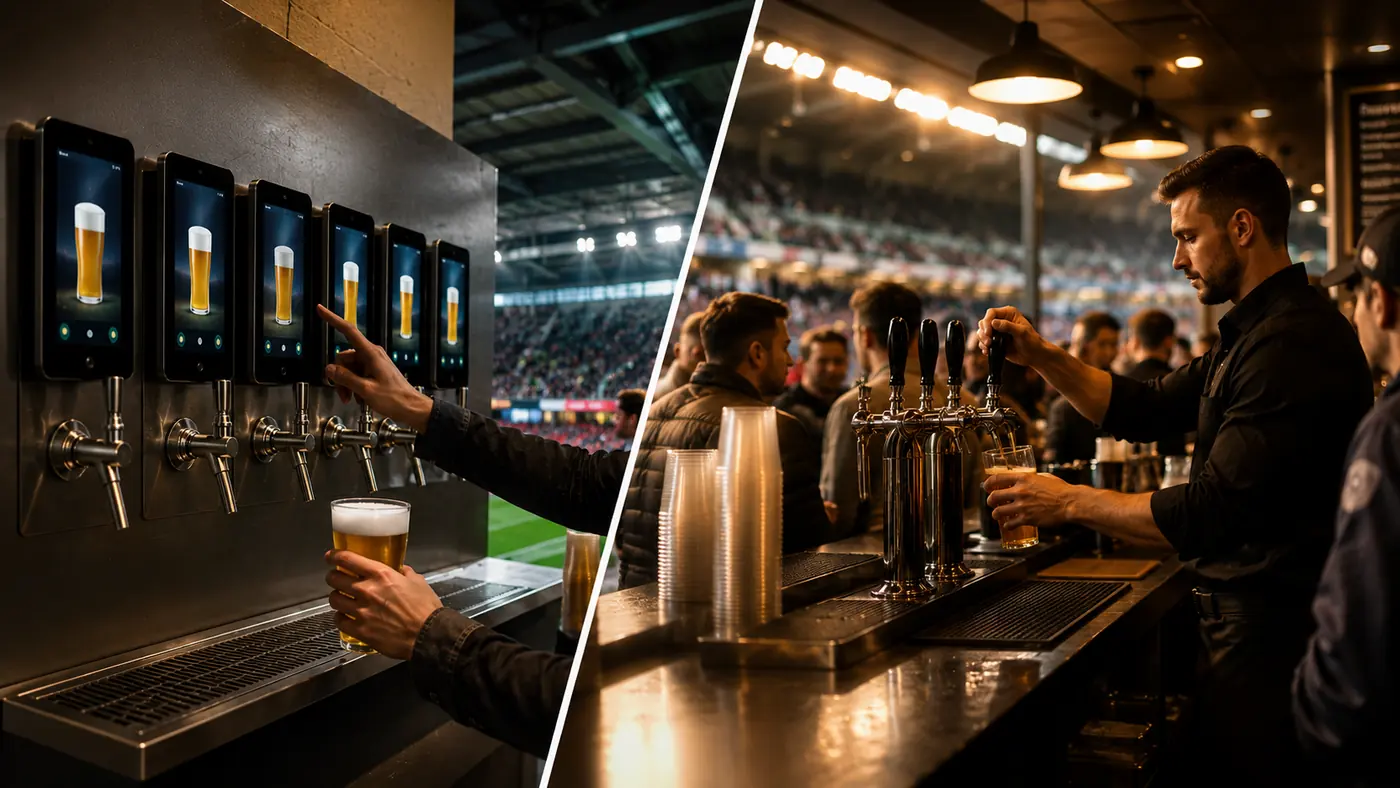
Self-Serve
Self-serve is an excellent solution for venues with a relatively consistent flow of customers throughout the day.
Examples include cricket grounds during test matches, multi-day festivals, visitor attractions and hospitality spaces where demand is spread over several hours.
These environments allow customers to serve themselves at their own pace, helping reduce labour requirements while providing a convenient customer experience.
However, venues such as football stadiums, concert arenas and racecourses typically experience a very different demand profile.
Instead of a constant flow of customers, they experience short periods of extremely high demand before kick-off, during half-time or between performances, followed by much quieter periods.
In these environments, self-serve is often better suited as a complementary solution rather than the primary method of service. It can absorb steady, day-long demand while other serving methods handle the busiest trading periods.
Key Benefits
- Lower labour requirements during steady trading.
- Customers can browse and purchase at their own pace.
- Scalable by adding additional dispense positions.
- Ideal for consistent, all-day demand.
- Can reduce waiting times during normal operation.
Considerations
- Throughput is largely determined by the number and width of the dispensing stations.
- Requires a permanent customer-facing footprint for dispensing and queueing.
- Greater upfront investment may be required for customer-facing dispense hardware and installation.
- First-time customers may need guidance and time to understand how to operate the device.
- Every customer must wait for their own drink to be poured.
- Drinks cannot be prepared ahead of predictable demand peaks.
Back Bar Optimisation
Back bar optimisation is particularly effective where demand arrives in short, predictable peaks.
Football stadiums, concert arenas and racecourses often experience large surges in customers immediately before kick-off, during half-time or between performances. In these situations, the operational priority is maximising throughput over a short period rather than reducing labour alone.
By increasing the productivity of the existing back bar and allowing drinks to be prepared ahead of peak demand, venues can serve more customers without increasing the physical size of the bar.
Key Benefits
- Maximises serving capacity during peak demand.
- Drinks can be prepared before predictable rushes.
- Makes better use of the existing back bar footprint.
- Maintains the beer quality and dispense standards expected by your existing brewery partners.
- Maintains traditional customer service.
- Reduces queue abandonment during busy periods.
- No additional customer floor space required.
- Higher throughput without expanding the bar.
Considerations
- Requires bar staff to serve customers.
- Existing flash coolers need enough capacity to keep up with the improved dispense output.
- Units are permanently installed into the bar setup, so the layout needs to support dedicated dispense positions.
- Delivers the greatest benefit where demand is concentrated into short, high-volume periods.
Comparison
| Factor | Self-Serve | Back Bar Optimisation |
|---|---|---|
| Best for consistent demand | Yes | Yes |
| Best for short, high-volume demand peaks | Good supplement | Yes |
| Reduces labour requirements | Yes | Yes |
| Maintains traditional customer service | No | Yes |
| Drinks can be prepared before peak demand | No | Yes |
| Handles sudden demand spikes | Limited | Excellent |
| Permanent customer queueing area required | Yes | No |
| Serving capacity linked to width of bar | Yes | No |
| Makes use of the existing back bar | No | Yes |
| Maximises customer floor space | Limited | Yes |
| Suitable as part of a hybrid solution | Yes | Yes |
Using Both Together
For many venues, the most effective solution is to combine both approaches.
Self-serve can absorb steady, day-long demand, while an optimised back bar handles predictable peaks when serving speed is most critical.
This creates a flexible operation that balances labour efficiency with maximum throughput, allowing venues to serve customers efficiently throughout the entire event.
Combined Benefits
- Self-serve reduces labour during steady trading.
- Back bar optimisation maximises throughput during peak demand.
- Greater resilience during busy events.
- Improved customer choice and flexibility.
- Better utilisation of available floor space.
- Increased sales through reduced queue abandonment.
- Allows each serving method to be used where it delivers the greatest value.
Final Thought: Where Is the Bottleneck?
Every venue is different, and there is no single solution that is right for everyone.
Rather than asking: "Should we invest in self-serve or back bar optimisation?"
Ask: "Where is the bottleneck in our operation?"
- Labour availability? Are you struggling to recruit or retain experienced bar staff?
- Pouring speed? Can your team physically pour drinks quickly enough to meet demand?
- Peak serving capacity? Can you serve everyone before kick-off, half-time or the interval ends?
- Customer floor space? Is valuable customer space being used for queueing instead of generating revenue?
- Bar footprint? Do you need to increase capacity without expanding the size of the bar?
- Customer experience? Are long queues causing customers to abandon purchases or miss parts of the event?
Once you understand your biggest constraint, the right investment often becomes much clearer.
For some venues, reducing labour through self-serve will deliver the greatest return.
For others, increasing back bar throughput will unlock significantly more sales during periods of peak demand.
For many operators, the answer is not one or the other. The greatest return often comes from using both approaches together, with each solving the part of the operation where it creates the most value.
The ultimate objective is simple: Invest where you can increase how quickly you serve customers.
Whether that means reducing labour, increasing pouring speed, improving throughput during peak demand, or making better use of your available space, identifying and removing the biggest bottleneck will usually deliver the greatest improvement in customer experience, operational efficiency and revenue.